Zhang, Hao and Eli Friedman. 2018. “Informality and Working Conditions
in China’s Sanitation Sector.” The China
Quarterly. Published online: 6 Dec 2018.
Thursday, 31 January 2019
Monday, 31 December 2018
Adam Mrozowicki's chapter, “Sociology of Work in Poland”
Mrozowicki, Adam. 2019. “Sociology
of Work in Poland.” Pp. 253-85 in The
Palgrave Handbook of the Sociology of Work in Europe, edited by Paul Stewart,
Jean-Pierre Durand and Maria-Magdalena Richea. Cham: Palgrave Macmillan.
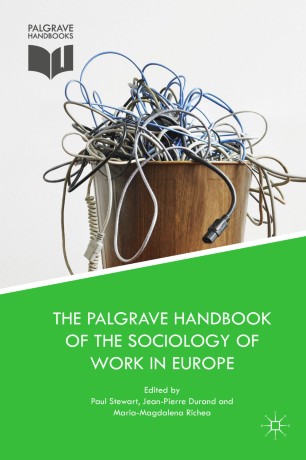

Sunday, 30 December 2018
Jörg Nowak "Brazil: Fascism on the verge of power?"
Brazil: Fascism on the Verge of Power?
Jörg Nowak
Dec 17, 2018
Socialist Project (SP)
The Bullet
Jörg Nowak is a political scientist at the University of Nottingham (UK) and co-editor of the magazine Rupture. His latest publications are “The Spectre of Social Democracy” in the Global Labour Journal, issue 3/2018, and the edited collection Workers Movements and Strikes in the Twenty-First Century. A Global Perspective. Rowman & Littlefield, 2018, co-edited with Peter Birke and Madhumita Dutta.
Saturday, 1 December 2018
Aleksandra Ålund and Carl-Ulrik Schierup "Making or unmaking a movement?"
Ålund, Aleksandra
and Carl-Ulrik
Schierup. 2018. “Making
or unmaking a movement? Challenges for civic activism in the global governance
of migration.” Globalizations 15(6): 809-823.
Schierup and coauthors "Migration, civil society and global governance"
Schierup, Carl-Ulrik,
Branka
Likić-Brborić, Raúl Delgado
Wise and Gülay Toksöz.
2018. “Migration,
civil society and global governance: an introduction to the special issue.” Globalizations 15(6): 733-45.
Marcel Paret “Critical Nostalgias in Democratic South Africa"
Paret,
Marcel. 2018. “Critical Nostalgias in Democratic South Africa.” The
Sociological Quarterly 59(4): 678-696.
Evidence
suggests that some black residents in South Africa experience nostalgia for the
racist and authoritarian apartheid regime. What dynamics
generate apartheid nostalgia, and what work does it do? This article
draws on in-depth interviews with black residents of impoverished urban
townships and informal settlements. I argue that by eliminating formal racial
discrimination and redirecting popular aspirations towards the state, South
Africa’s democratic transition encouraged apartheid nostalgia, which
residents deployed to criticize the post-apartheid state and imagine
alternative possibilities. Far from uniform, nostalgic expressions focused on
four objects: social protection, migrant exclusion, bureaucratic integrity, and
white governance. Each object represented an aspect of the apartheid state
that residents sought to resurrect. The analysis calls for a shift from a
politics of regret, focused on shame for past atrocities, to a politics of
nostalgia, which understands idealized projections of past objects as a terrain
of struggle.
Marcel Paret “Migration Politics”
Paret, Marcel. 2018. “Migration
Politics: Mobilizing Against Economic Insecurity in the United States and South
Africa.” International Journal of Comparative Sociology 59(1):
3-24.
From the mid-2000s, the United States
and South Africa, respectively, experienced significant pro-migrant and
anti-migrant mobilizations. Economically insecure groups played leading roles.
Why did these groups emphasize politics of migration, and to what extent did
the very different mobilizations reflect parallel underlying mechanisms?
Drawing on 41 months of ethnographic fieldwork and 119 interviews with
activists and residents, I argue that the mobilizations deployed two common
strategies: symbolic group formation rooted in demands for recognition, and
targeting the state as a key source of livelihood. These twin strategies
encouraged economically insecure groups to emphasize national identities and,
in turn, migration. Yet, they manifested in different types of mobilization due
to the varying characteristics of the groups involved, and the different
national imaginaries and organizing legacies they had to draw upon. The
analysis demonstrates the capacity of economically insecure groups to make
collective claims. It also shows that within the context of anti-migrant nationalism,
economic insecurity amplifies the significance of national belonging,
citizenship, and migration as important terrains of collective struggle.
Subscribe to:
Posts (Atom)